80% of CEOs Say AI Will Reshape Business

Gartner, a leading research and consulting company specializing in business and technology, has revealed in its latest survey that 80% of CEOs believe AI will significantly or moderately transform their organizations’ operational capabilities. This shift is driving businesses away from being merely “Digital Businesses” toward becoming “Autonomous Businesses.”

Don Scheibenreif, VP Analyst at Gartner, explained that “Autonomous Business” is a strategy centered around self-learning software agents and machine customers that can independently make decisions and create new forms of value for organizations. CEOs increasingly see this transition as an urgent operational priority. While digital business transformed what organizations do, autonomous business will fundamentally change how organizations operate.
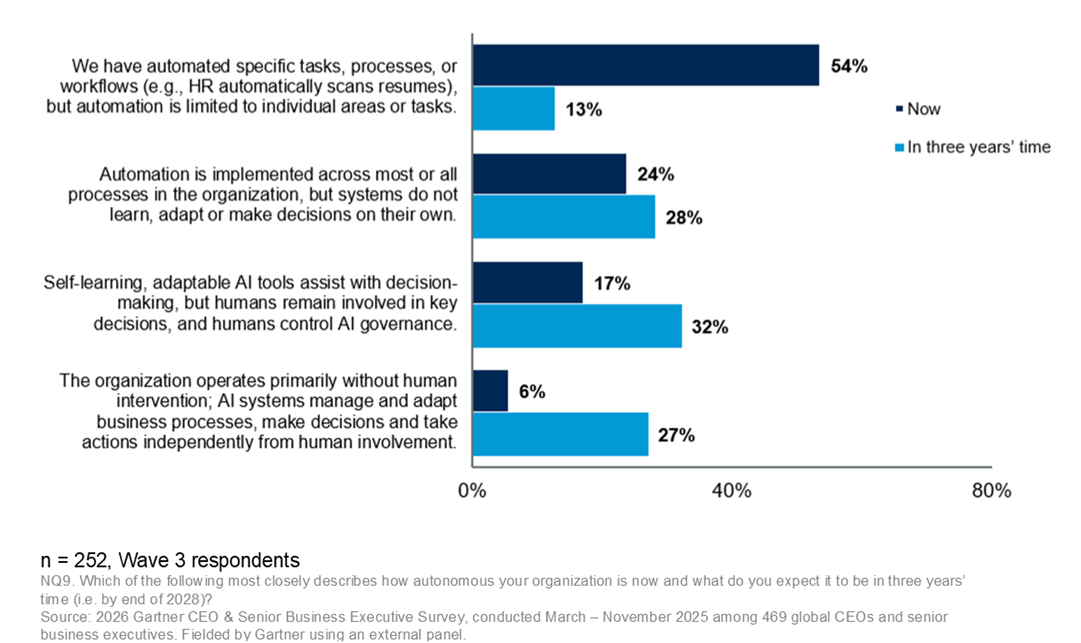
Gartner surveyed 469 CEOs and senior executives worldwide over a three-quarter period ending in Q4 2025. Key findings from the survey include:
• 54% of CEOs stated that their current automation efforts remain limited to certain tasks only.
• By the end of 2028, only 13% expect to remain at that same level of automation.
• 32% plan to adopt AI tools capable of self-learning and adaptive decision-making.
• 27% believe their organizations will operate with minimal human intervention, signaling a major shift toward fully autonomous business ecosystems.
David Furlonger, Distinguished VP Analyst at Gartner, stated that CEOs are beginning to recognize AI not simply as another layer of automation, but as a catalyst for rebuilding organizations from the ground up. To transition successfully into autonomous businesses, executives must adopt a “Capabilities First Mindset,” prioritizing operational capabilities and value delivery in an increasingly automated economy.
AI Threatens Transactional Revenue Models
Although automation and autonomous business models can improve efficiency, they may also disrupt existing competitive advantages. About 28% of CEOs believe transactional revenue streams — such as per-transaction fees — face the greatest risk from AI disruption. AI agents are increasingly capable of bypassing intermediaries and negotiating prices in real time.
“When AI agents begin handling procurement, pricing, and negotiations autonomously, they eliminate inefficiencies and unnecessary middle layers that transaction fees were originally designed to support. This forces organizations to rethink their profit models and shift toward recurring revenue or outcome-based business models to avoid margin erosion,” Furlonger added.
Customer Bases May Remain Stable
Only 17% of CEOs expect major changes in their customer bases due to AI, compared to 39% during the digital transformation era. Most business leaders are instead focused on using AI to deepen relationships with existing customers while expanding toward “Machine Customers.”
Gartner predicts that by 2026, the number of large enterprises with dedicated business units or sales channels targeting the rapidly growing machine customer market will double compared to 2024.
For senior executives, the findings also highlight the urgent need to build systems capable of supporting decision-making for both humans and machines, with trust, accuracy, and data integrity at the core.
“To prepare for this inevitable future, both CEOs and CIOs must lead the redesign of organizational operations and rethink workforce structures, assets, and financial models from the ground up,” Scheibenreif concluded.
Source : Gartner
PR : PC & Associates Consulting Co., Ltd. & FAQ Co., Ltd.